
Karnataka Rent Agreement Rules Everyone Must Know in 2026
Written By
Puneeth N
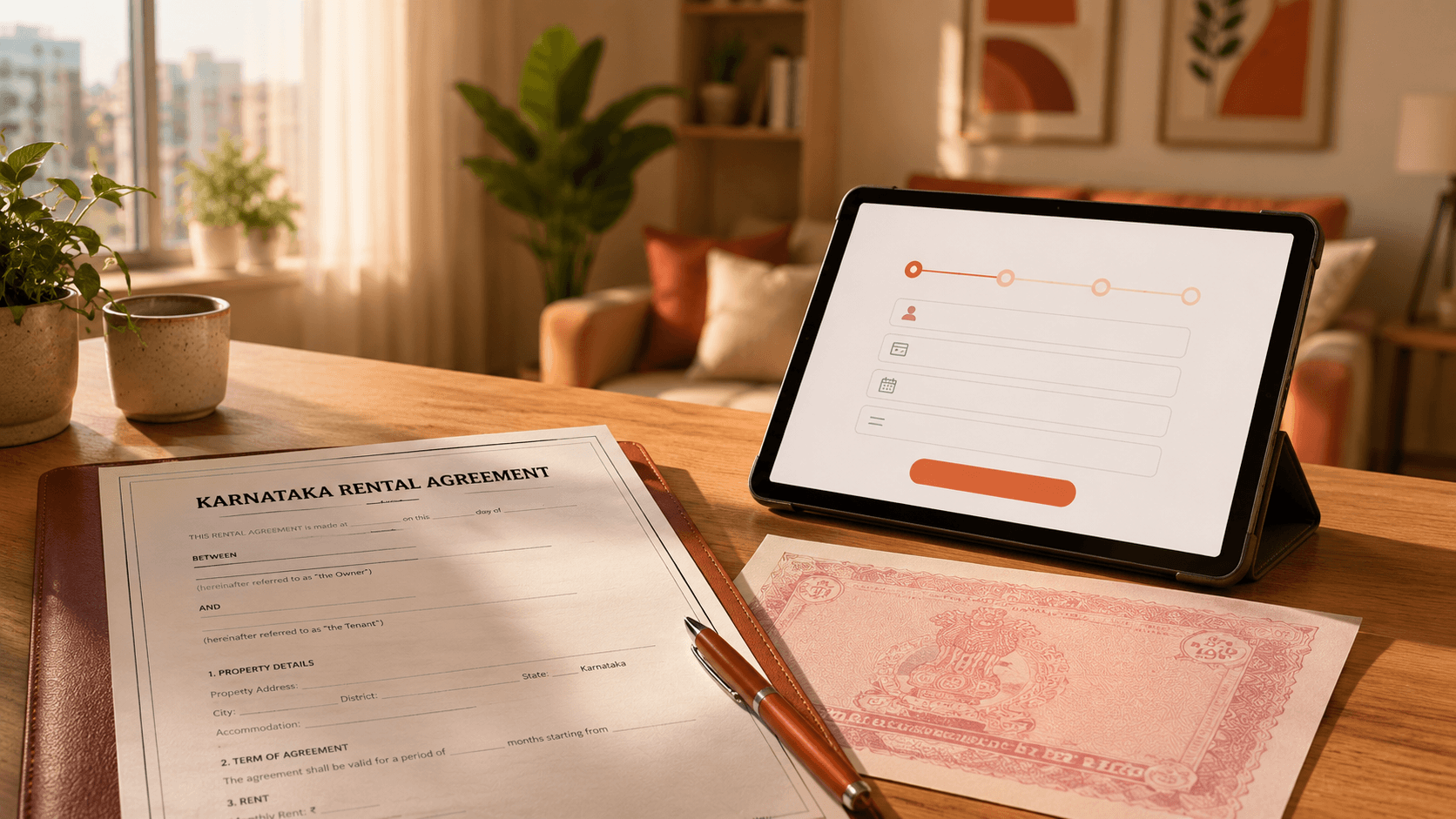
“The Karnataka Rent Amendment Act 2026 changed the rules on deposits, rent hikes, and landlord entry. Here is exactly what to check before you sign — and what to do if your landlord breaks the law.”
Karnataka Rent Agreement Rules Every Tenant Must Know in 2026
Most Bangalore tenants sign rental agreements they have not fully read, then discover too late that the deposit is above the legal cap, the rent hike clause is vague, or the agreement is not even registered. The Karnataka Rent Amendment Act 2026 changed the rules. Here is exactly what you need to check before you sign — and what to do if your landlord breaks them.
What changed in 2026: the Karnataka Rent Amendment Act
The Karnataka Rent Amendment Act 2026 sits on top of the Karnataka Rent Control Act 1999. It does not cap monthly rent amounts — rent is still negotiated between you and the owner — but it limits deposits, notice periods, and landlord behaviour during disputes. These changes apply to all new rental agreements signed from 2026 onwards.
Here is the timeline of what took effect:
- January 2026: Security deposit capped at 2 months' rent — legally enforced statewide
- February 2026: Digital registration via Kaveri Online Services Portal made mandatory for new agreements
- March 2026: 90-day written notice before any rent hike became mandatory
- May 2026: 24-hour entry notice rule enforced — no more surprise inspections
If your existing agreement predates 2026, you are still protected by the core provisions of the Karnataka Rent Control Act 1999 for eviction, utility cutoffs, and forced entry. But any new agreement, renewal, or amendment from 2026 onwards must follow the new rules.
The 7 rules every tenant must verify before signing
-
Security deposit must not exceed 2 months' rent
The Act legally caps residential security deposits at 2 months' rent. On a ₹25,000/month flat, the maximum legal deposit is ₹50,000. Anything above that is non-compliant and unenforceable at the Rent Tribunal. If an owner asks for 5 or 10 months, cite the Act and negotiate it down. If they refuse, that is a signal about how the tenancy will go.
-
The agreement must be written — verbal agreements are invalid
From 2026, verbal tenancy agreements have no legal standing in Karnataka. Every tenancy must have a written agreement. If an owner offers a "handshake deal," insist on a written document. Your bank transfer records and WhatsApp messages can serve as proof of tenancy if the owner refuses to provide a written agreement, but a proper agreement is your strongest protection.
-
Register the agreement via Kaveri Online Services Portal
For agreements of 11 months or less, registration is recommended but not mandatory. For anything longer, registration is required. The Kaveri portal allows fully digital, paperless registration — you purchase e-stamp paper online, enter party details, e-sign, and download the final PDF. Unregistered agreements carry limited legal weight in court and can attract penalties up to 10 times the original stamp duty value.
-
Rent hike clause: 90 days written notice, once per year
Your landlord cannot send a WhatsApp message on the 28th saying rent goes up next month. The 2026 amendment mandates 90 days written notice for any rent revision. The notice must be in writing — email or letter — not verbal. Rent can only be increased once per year. Check your agreement for this clause before signing. If it is missing or vague, add it.
-
Landlord entry: 24 hours written notice, sunrise to sunset
Your landlord cannot knock on your door unannounced. The Act requires minimum 24 hours written notice before entering for inspection or repair. Entry must happen between sunrise and sunset. Emergency exceptions apply only for water leaks, fire, or structural safety issues. Repeated violations can be reported to the Rent Authority.
-
Utilities cannot be cut during disputes
Even if you have a rent dispute or deposit disagreement, your landlord cannot cut off your water, electricity, or sanitation. Access to these is treated as a fundamental right under the Act. Cutting utilities as retaliation is a criminal act and can attract penalties up to ₹50,000. If this happens, call BESCOM or BWSSB directly and file a complaint, then report to the Rent Authority.
-
Police verification is the owner's responsibility
Tenant police verification is mandatory in Bangalore, but it is the owner's legal responsibility to register your details with Bangalore City Police through the Karnataka Police e-Services portal within 24 hours of move-in. If they do not, the penalty falls on them, not you. Cooperate with verification anyway — it protects you as a verified tenant.
Stamp duty and registration charges in Karnataka
Stamp duty is the government tax that makes your agreement legally enforceable. In Karnataka, the rates are straightforward:
| Agreement term | Stamp duty | Registration charges |
|---|---|---|
| Up to 10 years | 1% of annual rent + deposit | 1% of annual rent + deposit |
| Above 10 years | 2% of annual rent + deposit | 1% of annual rent + deposit |
For a ₹25,000/month flat with a ₹50,000 deposit on an 11-month agreement, the annual rent is ₹3,00,000. Stamp duty is 1% of ₹3,50,000 = ₹3,500. Registration charges are another 1% = ₹3,500. Total government fees: approximately ₹7,000. This is typically split between owner and tenant, but negotiate who pays what before signing.
Karnataka is a pioneer in e-stamping. Traditional stamp papers are almost fully replaced by e-stamp papers, which are secure, tamper-proof, and available instantly through the Kaveri portal or licensed vendors.
Key clauses every rental agreement must include
A weak agreement is the single biggest reason tenants lose disputes. Before you sign, verify these 8 clauses are present and clearly worded:
- Lock-in period: Minimum period before either party can terminate without penalty
- Rent and deposit: Exact amount, mode of payment, due date, and late payment penalty if any
- Maintenance charges: Who pays for electricity, water, society fees, and common area maintenance
- Repairs and alterations: Who handles structural repairs vs. day-to-day maintenance; tenant cannot alter structure without written consent
- Overstay clause: Penalty if tenant continues after agreement expiry without renewal
- Rent escalation: Annual increase percentage (standard is 5–10%) and the 90-day notice requirement
- Notice period for vacating: Typically 1–2 months written notice from either side
- Deposit refund terms: Timeline (usually 30–60 days) and lawful deductions only
If any of these clauses are missing, ask the owner to add them. A broker-mixed agreement often omits tenant protections because the broker has no incentive to protect you. An owner-direct agreement gives you the room to negotiate every clause.
Eviction rules: when a landlord can and cannot remove you
Eviction is where most tenants feel powerless. The 2026 Act makes the rules clear. A landlord can only evict you for specific legal reasons, and eviction requires a court order. Physical removal, lock-changing, or threats without a court order are criminal acts.
| Legal grounds for eviction | Illegal eviction (criminal) |
|---|---|
| 3+ months of unpaid rent | Landlord wants to sell the property |
| Illegal activity on premises | Found a higher-paying tenant |
| Major property damage beyond normal wear | Wants property for renovation |
| Unauthorized subletting | Personal dislike of tenant |
| Court order obtained through due process | No written notice given |
If you are threatened with forced eviction, do not vacate. Call the police if physically threatened, and approach the Rent Control Court for a stay order. Document everything — WhatsApp screenshots, bank transfers, photos, and dates. This is your evidence.
What to do if your landlord violates your rights
⚠ Step-by-step escalation
Follow this flow when your rights are violated — document first, then escalate.
Step 1: Document everything
WhatsApp screenshots, bank transfer records, photos of the property condition, and dates. This is your evidence for any complaint to the Rent Authority or consumer court.
Step 2: Send written notice to the landlord
State the violation, cite the Karnataka Rent Amendment Act 2026, and give 7 days to resolve in writing. Send this via email or registered post so you have delivery proof.
Step 3: File a complaint with the Rent Authority
For deposit disputes, illegal eviction threats, utility cutoffs, or unregistered agreements, file a complaint with the Karnataka Rent Authority via BBMP or your local municipal office. For criminal acts like forced eviction, also file a police complaint.
Step 4: Escalate to Consumer Court or Civil Court
If no resolution within 60 days, file a suit for damages — especially for deposit refusal, illegal eviction, or unlawful deductions. You can claim the deposit amount plus interest.
Moving out: how to protect your deposit refund
Deposit disputes are the most common post-tenancy conflict in Bangalore. Protect yourself with this checklist:
- Send written vacating notice per your agreement — keep delivery proof
- Pay rent through the valid notice period unless the owner accepts early exit in writing
- Conduct a joint inspection with the owner and take date-stamped photos of all rooms and meter readings
- Return all keys and get a written acknowledgement
- Deposit refund is typically due within 30–60 days; challenge unlawful deductions at the Rent Tribunal
Lawful deductions from your deposit include only unpaid rent, unpaid utility bills, and proven damage beyond normal wear and tear. Illegitimate deductions include repainting after normal tenancy, pre-existing damage, and normal wear and tear. If the owner refuses to refund within 60 days, send a legal notice via registered post, then approach the consumer court.
Why a registered agreement matters more than ever
Everything in this guide depends on one document: your registered rental agreement. An unregistered agreement is weak evidence in court. A registered agreement is proof of tenancy, proof of terms, and proof of payment structure. It is the difference between winning and losing a dispute.
The Kaveri Online Services Portal makes registration fully digital. You do not need to visit a Sub-Registrar's office. You purchase e-stamp paper online, fill in party details, e-sign the document, and receive a registered copy. The entire process takes under 30 minutes if both parties have their documents ready.
When you rent directly from a verified owner, you negotiate the agreement terms face-to-face. There is no broker adding vague clauses or rushing you to sign. You see exactly what you are agreeing to — and you have the time to verify every clause against the 2026 Act before you commit.
Before you search, read our guide on how to rent a house in Bangalore without a broker to save ₹15,000–₹60,000 in commission. If you are ready to list your own property, see how to list your property for rent online.
Rent with confidence in Bangalore
Verified owner listings. Zero brokerage. Agreements that follow 2026 rules.
Browse listings on rentley Free to search · No broker · Aadhaar-verified ownersLooking for a home?
Browse verified rentals directly from owners. No brokerage, no hidden fees.
Explore Listings